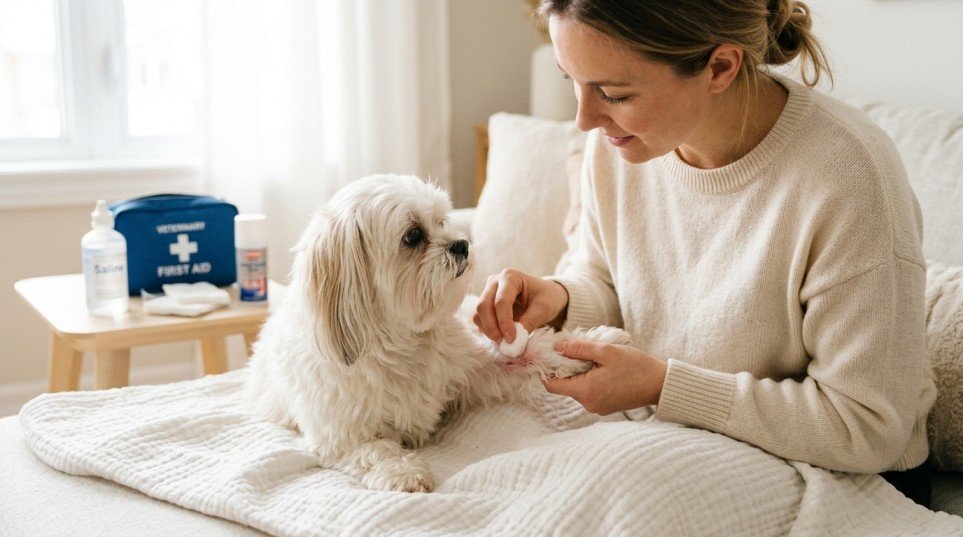
Light Skin Scrapes on Small Dogs? Safe Home Treatments That Work 2026
Quick Answer: For a surface-level scrape with no deep tissue visible, no bleeding that will not stop, and no signs of infection, a gentle saline rinse followed by a vet-safe antiseptic is usually enough. Human antiseptics like hydrogen peroxide, rubbing alcohol, and iodine are not safe for dog skin and should not be used.
Your small dog came in from the yard limping a little, and you spot a light scrape on their leg. Before you reach for the first thing in your medicine cabinet, stop. What is safe for humans is not always safe for a 10-pound dog. This guide gives you the full, vet-backed picture on treating minor skin scrapes at home.
We cover every question small dog owners actually search for: which home remedies are genuinely safe, which ones to avoid entirely, how to clean and protect a light scrape properly, and exactly when a small wound needs a vet instead of a home fix.
Home Remedies for Light Skin Scrapes: The Short Answer
A light skin scrape on a small dog can usually be treated at home using gentle cleaning and one of a small number of vet-safe topical options. The goal is to clean the wound, prevent infection, and keep your dog from licking it.
The debate around home remedies exists because some options work well and are genuinely safe, while others are actively harmful. Small dogs are especially vulnerable because their skin is thinner, they weigh less (so even small amounts of a toxic substance matter more), and they are efficient at licking wounds, which means whatever you put on the scrape ends up in their mouth.
What Counts as a Light Skin Scrape on a Small Dog?
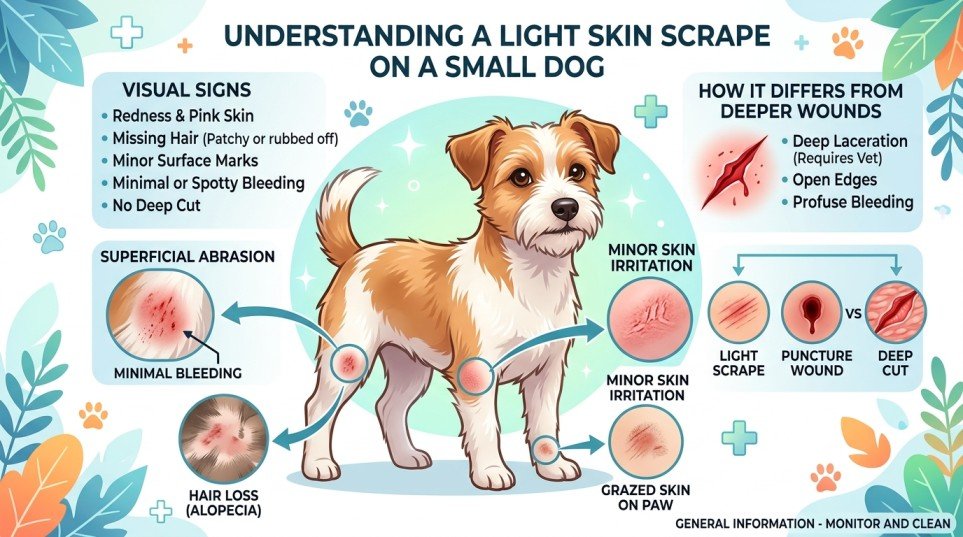
Not every wound belongs at home. Before you treat anything, it helps to know exactly what qualifies as a minor scrape versus something that needs professional care.
A light skin scrape typically looks like this:
- A shallow abrasion that affects only the top layer of skin (the epidermis)
- Mild redness or slight oozing, but not active bleeding that pools or flows
- Small surface area, usually under an inch in diameter
- No visible tissue, muscle, or fat underneath
- No swelling, discharge, or foul smell
Seek veterinary care immediately if you see:
- Bleeding that does not slow within 5 minutes of gentle pressure
- A wound deeper than the skin surface or with visible tissue underneath
- Swelling, warmth, or pus around the wound
- Your dog refusing to bear weight, crying, or showing signs of significant pain
- A wound near the eye, ear, or genitals
- Any bite wound, even if it looks minor on the outside
Important: Bite wounds are never minor, even when the skin opening is small. They carry a high risk of deep tissue infection and abscess and always need a vet visit.
Why Small Dogs Need Extra Care With Skin Wounds
A lot of wound care advice online is written for medium to large dogs. Small dogs, including Chihuahuas, Dachshunds, Shih Tzus, Yorkies, Maltese, and similar breeds, have some important differences that change how you approach home treatment.
1. Lower Body Weight Means Higher Sensitivity to Topical Products
A substance applied to the skin of a 10-pound dog is proportionally a much higher exposure than the same product on a 60-pound dog. This matters especially when your dog licks the wound. Essential oils, certain antiseptics, and medicated creams can reach toxic concentrations in small dogs through licking alone.
2. Thinner Skin Is More Prone to Irritation
Small breeds often have more delicate skin than large dogs. Harsh antiseptics that large dogs tolerate reasonably well can cause chemical burns or tissue damage in small dogs. This is one of the key reasons hydrogen peroxide is not recommended for any dog wound, and especially not for small breeds.
3. Small Dogs Lick More Efficiently
Due to their size and flexibility, small dogs are often better at reaching wounds on their legs, belly, and back than large dogs. An Elizabethan collar (cone) is nearly always necessary after treating a wound on a small dog, because whatever you apply will be licked off quickly otherwise, reducing its effectiveness and putting the substance into your dog’s stomach.
Safe Home Remedies for Light Skin Scrapes on Small Dogs
1. Saline Solution (Salt Water Rinse)
This is the single safest and most universally recommended first step for any minor dog wound. A saline rinse gently removes dirt, debris, and surface bacteria without damaging healthy tissue.
How to make it at home:
- Mix 1 teaspoon of plain non-iodized salt into 2 cups of clean, room-temperature water
- Stir until fully dissolved
- Use a clean syringe, squeeze bottle, or soaked gauze to rinse the wound gently
- Pat dry with a clean cloth or sterile gauze, do not rub
Saline is isotonic, meaning it matches the salt concentration of your dog’s body fluids. It cleans without stinging, causing tissue damage, or interfering with healing. You can also purchase sterile saline wound wash from most pharmacies.
2. Diluted Chlorhexidine Solution
Chlorhexidine is a veterinary-grade antiseptic and is one of the most commonly recommended wound care products by vets for minor skin injuries in dogs. The key word is diluted. Full-strength chlorhexidine can be irritating. The correct concentration for wound rinsing is 0.05 percent.
How to dilute it correctly:
- Start with 2 percent or 4 percent chlorhexidine solution (available at pet stores and pharmacies)
- For a 0.05 percent solution: mix 1 part chlorhexidine with 39 parts water (for 2 percent) or 79 parts water (for 4 percent)
- The resulting solution should be a very pale blue or nearly clear
Apply with a soaked cotton ball or gauze. Do not rinse it off after application. Let it air dry. This is a genuinely vet-recommended option for small dogs when used at the right dilution.
3. Plain Aloe Vera Gel
Aloe vera has well-documented anti-inflammatory and soothing properties. For a light scrape that is already clean, a small amount of plain aloe vera gel (not aloe products containing alcohol, fragrances, or additives) can help reduce redness and provide a mild soothing effect.
Important cautions for small dogs:
- Use only pure, food-grade or cosmetic-grade aloe gel with no added ingredients
- Aloe contains compounds called anthraquinones in the latex layer just under the leaf skin. These are mildly toxic to dogs if ingested in larger amounts
- Apply a thin layer only and use a cone to prevent licking
- Do not apply to deep wounds, infected wounds, or anywhere your dog cannot be kept from licking
4. Manuka Honey
Medical-grade Manuka honey has been studied for wound healing in veterinary settings and has genuine antibacterial properties. It creates a moist healing environment and has been shown to inhibit bacterial growth including some antibiotic-resistant strains.
How to use it on a small dog:
- Use only medical-grade or UMF-rated Manuka honey, not regular kitchen honey
- Apply a thin layer directly to the cleaned wound
- Cover loosely with a non-stick sterile dressing to prevent licking
- Change the dressing every 12 to 24 hours
The challenge with Manuka honey on small dogs is that they will try to eat it. A properly fitted cone is essential. Regular honey is not a substitute and is not recommended due to sugar content and lack of medicinal properties.
5. Calendula Rinse
Calendula (pot marigold) has a long history in herbal medicine as a wound-soothing agent. It has mild anti-inflammatory properties and is generally considered safe for topical use on dogs when prepared correctly.
How to prepare a calendula rinse:
- Steep 1 tablespoon of dried calendula flowers in 2 cups of just-boiled water
- Allow to cool completely to room temperature
- Strain out all plant material before use
- Apply with clean gauze to the scrape, let air dry
Do not use commercial calendula products that contain essential oils or alcohol. Do not apply to deep wounds. This remedy is gentle and low-risk, making it one of the more suitable options for sensitive small breeds.
6. Coconut Oil (Use With Caution)
Coconut oil has antimicrobial properties and can help maintain skin moisture around a healing scrape. However, it is widely overused as a home remedy and has some important limitations.
What coconut oil can and cannot do:
- It can moisturize dry skin around the wound edges and provide a mild barrier
- It does not have strong enough antiseptic properties to replace a proper wound rinse
- It is high in fat and can cause stomach upset or loose stools if your dog licks significant amounts
- Use only unrefined, virgin coconut oil in a thin layer, and use a cone
Coconut oil is more useful as a maintenance measure on a healing wound than as initial treatment. For the first cleaning, saline or diluted chlorhexidine is a better choice.
Home Remedy Quick Reference Table
| Home Remedy | Best For | How It Helps | Verdict |
| Saline rinse | Dirt and debris removal | Flushes bacteria and particles gently | Always first step |
| Diluted chlorhexidine | Mild bacterial prevention | Antiseptic, vet-recommended | Safe and effective |
| Plain aloe vera gel | Soothing redness | Anti-inflammatory, cooling | Small amounts only |
| Manuka honey | Slow-healing minor scrapes | Natural antibacterial properties | Thin layer, supervised |
| Calendula rinse | General wound soothing | Herbal anti-inflammatory | Gentle, low risk |
| Coconut oil | Skin moisture barrier | Moisturizes dry wound edges | Use sparingly |
| Vet wound spray | Any skin scrape | Formulated for dogs, safe if licked | Best overall option |
What NOT to Use on a Small Dog Skin Scrape
This section is just as important as the remedies listed above. Many home wound care products that humans use regularly are actively harmful to dogs.
Hydrogen Peroxide
This is probably the most common wound care mistake dog owners make. Hydrogen peroxide destroys fibroblasts, which are the cells responsible for forming new tissue. Using it on a wound actively slows healing and can damage healthy skin around the scrape. It is not recommended for dogs by any major veterinary organization.
Rubbing Alcohol or Isopropyl Alcohol
Alcohol is painful on open wounds, causes significant stinging and tissue damage, and is toxic if licked. Never apply it to any dog wound, regardless of size.
Iodine (Undiluted)
Full-strength iodine is too harsh for dog skin. It can cause chemical burns and stains tissue in a way that makes it harder to monitor healing. Diluted povidone-iodine in a very specific ratio (to a weak tea color) is sometimes used by vets, but undiluted iodine products should not be applied at home.
Human Antibiotic Ointments (Neosporin)
This one requires nuance. Plain Neosporin (neomycin, polymyxin B, bacitracin) is generally considered low-risk for short-term use on small skin wounds in dogs. However, Neosporin Plus (which contains pramoxine, a pain reliever) should be avoided. More importantly, many dogs lick any ointment off immediately, and repeated ingestion of antibiotic ointment is not safe. A vet-formulated product is a safer choice.
Tea Tree Oil and Essential Oils
Tea tree oil is toxic to dogs even in small topical amounts. Small dogs face the highest risk because of their lower body weight. Even diluted tea tree oil can cause tremors, weakness, and in severe cases, neurological damage in small dogs. No essential oil should be applied to a dog wound.
Witch Hazel
Many witch hazel products contain alcohol, which is harmful. Alcohol-free witch hazel is less dangerous but provides minimal wound care benefit and is not worth the risk of a small dog licking it.
Step-by-Step: How to Treat a Light Skin Scrape on a Small Dog at Home
Step 1: Stay Calm and Assess the Wound
Dogs pick up on owner anxiety. Stay calm, speak in a low voice, and gently restrain your dog on a flat surface or in your lap. Have a second person help if your dog is wiggly.
Check the wound for depth, size, active bleeding, and debris. If anything looks deeper than skin surface level, skip home treatment and call your vet.
Step 2: Trim Hair Around the Area (If Needed)
Long-coated breeds, including Shih Tzus, Maltese, and Yorkies, may have fur covering a scrape. Use blunt-tipped scissors to carefully trim hair away from the wound edges so you can see and clean the area properly. This also prevents hair from sticking to the wound during healing.
Step 3: Flush the Wound With Saline
Gently flush the scrape using a saline solution and a clean syringe or squeeze bottle. Use enough solution to rinse away all visible dirt and debris. Do not scrub. Pat dry with a clean cloth.
Step 4: Apply a Safe Antiseptic
Apply diluted chlorhexidine solution (0.05 percent) with a cotton ball or sterile gauze. Let it air dry. If you do not have chlorhexidine, a vet wound spray formulated for dogs is a reliable over-the-counter alternative.
Step 5: Protect the Wound
For very small, surface scrapes on the body, a light non-stick sterile pad held in place with medical tape or a soft bandage wrap can provide protection. Change this every 12 to 24 hours.
For scrapes on paws or legs, a dog sock or boot can help keep the area clean between dressing changes.
Step 6: Use a Cone or Recovery Suit
This is non-negotiable for small dogs. Without a cone or recovery suit, your dog will lick the wound and any product you have applied within minutes. An Elizabethan collar (cone) is the most reliable option. Soft inflatable collars work for some dogs but may not prevent licking in flexible small breeds.
Step 7: Monitor Closely for 48 to 72 Hours
Check the wound at least twice daily. You should see gradual improvement: less redness, the wound beginning to close, and no new discharge.
Signs of Infection to Watch For
A light scrape that is healing normally will look better each day. A scrape that is getting infected will look worse. Contact your vet if you see any of the following:
- Increasing redness spreading away from the wound edges
- Swelling or warmth around the wound that was not there before
- Yellow or green discharge, or discharge with a bad smell
- The wound not closing or appearing to get larger
- Your dog developing a fever, becoming lethargic, or losing appetite
- Your dog showing increasing pain around the wound
Infections in small dogs can progress faster than in large dogs due to their smaller body mass. Do not wait several days to call your vet if any of these signs appear.
When to Call the Vet Instead of Treating at Home
Home treatment is appropriate for genuinely minor scrapes. The following situations go beyond home care:
- The wound is deeper than the skin surface
- Bleeding does not slow or stop with 5 minutes of gentle pressure
- The wound was caused by another animal (always a vet visit regardless of appearance)
- You see any sign of infection as described above
- Your dog is in significant pain or will not let you near the wound
- Your dog is very young (under 6 months), aged, or has a health condition that affects healing
- The wound is near the eye, ear, or a joint
The bottom line: when in doubt, call. A quick vet consultation costs less than treating an infected wound later. A phone call to your vet or a pet telehealth service can often confirm whether home treatment is appropriate without a full clinic visit.
Over-the-Counter Products Worth Keeping in Your Small Dog First Aid Kit
Alongside home remedies, these vet-recommended products are worth having on hand for a small dog household:
- Sterile saline wound wash: Often sold as wound irrigating solution at pharmacies. Safe, ready to use, and effective.
- Chlorhexidine solution or spray: Available at pet stores. Look for products formulated for dogs with a concentration suitable for wound rinsing.
- Non-stick sterile pads and medical tape: For light wound coverage. Non-stick pads do not pull at healing tissue when changed.
- Blunt-tipped bandage scissors: For trimming fur around a wound and cutting bandage material safely.
- Cone or inflatable collar: Keep one sized for your dog before you need it, not after.
- Vet-formulated wound spray: Products like Vetericyn or similar vet-approved wound sprays are safe if licked and effective for minor wounds.
Frequently Asked Questions: Home Remedies for Small Dog Skin Scrapes
Can I use Neosporin on my small dog’s scrape?
Plain Neosporin (triple antibiotic ointment without pain reliever) is generally considered low-risk for a single, brief application on a minor scrape. However, it is not formulated for dogs, and small dogs who lick it off repeatedly may experience stomach upset. A vet-formulated wound product is a safer choice for regular use.
Is coconut oil safe for a dog skin scrape?
Coconut oil is safe in small amounts and can help moisturize around a healing wound. It is not strong enough to use as the primary antiseptic and will be licked off quickly without a cone. Use it as a supplemental moisture barrier on a healing wound rather than as the main treatment.
Can I use hydrogen peroxide on my dog?
No. Hydrogen peroxide damages the cells needed to repair tissue and is not recommended by veterinary organizations for wound care in dogs. It was once commonly used, but current veterinary guidance is to avoid it entirely.
What can I use to clean a dog wound if I have nothing at home?
Plain clean water is far better than nothing and better than reaching for a harmful antiseptic. Flush the wound thoroughly with clean, room-temperature water, pat dry, and keep your dog from licking it while you get proper wound care supplies.
How long should a light scrape take to heal on a small dog?
A genuinely light surface scrape on a healthy small dog typically begins to close within 2 to 3 days and is largely healed within 7 to 10 days. If you are not seeing improvement by day 3 or 4, contact your vet.
My small dog keeps licking the scrape even with a cone. What do I do?
Some dogs are very determined about licking. If a standard cone is not working, try a soft inflatable collar combined with a recovery suit or t-shirt to cover the wound area. For paw wounds, a dog boot or sock secured properly can help. If the wound is in a location where licking truly cannot be prevented, contact your vet for guidance on a proper bandage or professional treatment.
Should I cover a small dog scrape or leave it open to air?
Light scrapes benefit from being kept clean and lightly covered for the first 24 to 48 hours to protect them from dirt and self-trauma. After the initial wound closes, some air exposure can support healing. The most important factor is preventing licking, which is more damaging than whether the wound is covered or not.
Final Word: Should You Treat Your Small Dog’s Scrape at Home?
A light surface scrape on a healthy small dog can absolutely be treated at home with the right approach. The key is using genuinely safe products, cleaning the wound properly first, and keeping your dog from licking the treatment off.
The most reliable approach is a saline rinse followed by diluted chlorhexidine or a vet-formulated wound spray, combined with a cone. Natural options like aloe vera and Manuka honey have real benefits but require careful application and strict licking prevention.
What matters most is knowing when home treatment is not enough. If the wound looks deeper than skin level, shows any signs of infection, or does not improve within a few days, your vet is the right call. Small dogs can develop complications faster than larger breeds, and early professional care is always less expensive than treating a wound that has become infected.
When in doubt, skip the guessing and call your vet. Your small dog depends on you to make that call.
Sources and References
- Merck Veterinary Manual: Wound Management in Small Animals. merckvetmanual.com
- VCA Animal Hospitals: First Aid for Cuts and Wounds in Dogs. vcahospitals.com
- PetMD: How to Clean a Dog Wound at Home (Updated 2025). petmd.com
- American Kennel Club: How to Treat Minor Dog Cuts and Scrapes. akc.org
- Veterinary Partner: Wound Care for Pets. veterinarypartner.vin.com
- ASPCA Animal Poison Control Center: Pet Safety Information. aspca.org
Discover More:-
- What to Do If Your Dog Eats Chocolate: Home Remedies, Vet Steps, and the Full SafetyGuide 2026
- How to Stop Dog from Licking Paws Home Remedy: complete Vet-Backed Guide 2026

Dr. Ubaid Ur Rehman, DVM is a qualified veterinarian with expertise in pet health, nutrition, and preventive care. He is passionate about helping pet owners make informed decisions through accurate, research-based, and practical advice. As a veterinary professional, he reviews and contributes content to ensure reliable information for dog and pet owners.