Dog Ramp for Car: 10 Best Picks for Easy & Safe Travel 2026
Quick Ans: Your dog hesitates at the car door. Maybe they used to jump in without a second thought, but lately they hold back. They are getting older. Maybe they just had surgery. They are still a puppy and those back legs have not caught up with the rest of them yet.
A dog ramp for the car is one of the simplest, most effective things you can do for your dog’s joint health. But with dozens of options on the market and a lot of conflicting advice online, figuring out which one to buy, how to use it, and how to get your dog to actually walk up it is not obvious.
This guide covers everything: why ramps matter, how to pick the right one for your dog and your vehicle, the top options in every category, and a step-by-step plan for training even the most ramp-resistant dog.
Why Your Dog Needs a Ramp for the Car
Most dog owners assume their dogs can handle jumping in and out of cars indefinitely. The reality is more complicated, and the consequences of repeated high-impact jumping can be serious.
The Joint Impact Problem
Every time a dog jumps down from a car seat, SUV cargo area, or truck bed, the impact force on their front legs and shoulders is significant. For large and giant breeds, that force can equal many times their body weight. Over months and years, this repeated strain contributes to:
- Elbow and shoulder dysplasia in large breeds
- Worsening of existing hip dysplasia
- Early onset arthritis in dogs as young as four or five years old
- Torn cruciate ligaments (one of the most common and expensive orthopedic injuries in dogs)
Who Needs a Dog Car Ramp Most
A ramp is not just for senior dogs. Veterinary orthopedic specialists now recommend ramp use for:
- Senior dogs (typically 7 and older for large breeds, 9 and older for small breeds)
- Dogs recovering from orthopedic surgery, including cruciate repair and hip replacements
- Breeds with known joint issues such as Dachshunds, Basset Hounds, Corgis, and German Shepherds
- Heavy dogs, where extra mass amplifies every landing
- Young puppies, whose growth plates are still developing and vulnerable to impact damage
- Small dogs who are simply too short to leap comfortably into taller vehicles
If your dog falls into any of these categories, a ramp is not optional. It is a health decision.
Dog Ramp vs. Dog Stairs for Car: Which Is Better?
Both ramps and stairs can get your dog safely in and out of the car. The right choice depends on your dog’s size, mobility, and confidence level.
Dog Car Ramp
- Continuous incline with no steps to navigate
- Better for dogs with mobility issues, arthritis, or post-surgical recovery
- Easier for dogs who are unsure or anxious, since there is no need to judge step height
- Typically longer and takes more storage space than stairs
Dog Car Stairs
- Shorter and more compact for storage
- Works well for confident, agile dogs with no joint issues
- Not recommended for dogs with hip or elbow problems
- Can be tricky for dogs with long bodies and short legs
The bottom line: for any dog with joint concerns, mobility challenges, or a history of orthopedic issues, a ramp is the better choice. For healthy, agile small dogs being loaded into a standard sedan, stairs may work fine.
How to Choose the Right Dog Ramp for Your Car
Not all dog ramps are built the same, and choosing the wrong one will leave you with a ramp your dog refuses to use or one that is not safe for your vehicle.
1. Match the Ramp to Your Vehicle Height
Measure the height of your car’s cargo area, back seat, or truck bed from the ground before purchasing. Common vehicle heights:
- Standard sedan: 18 to 22 inches
- SUV cargo area: 24 to 30 inches
- Truck bed: 28 to 36 inches
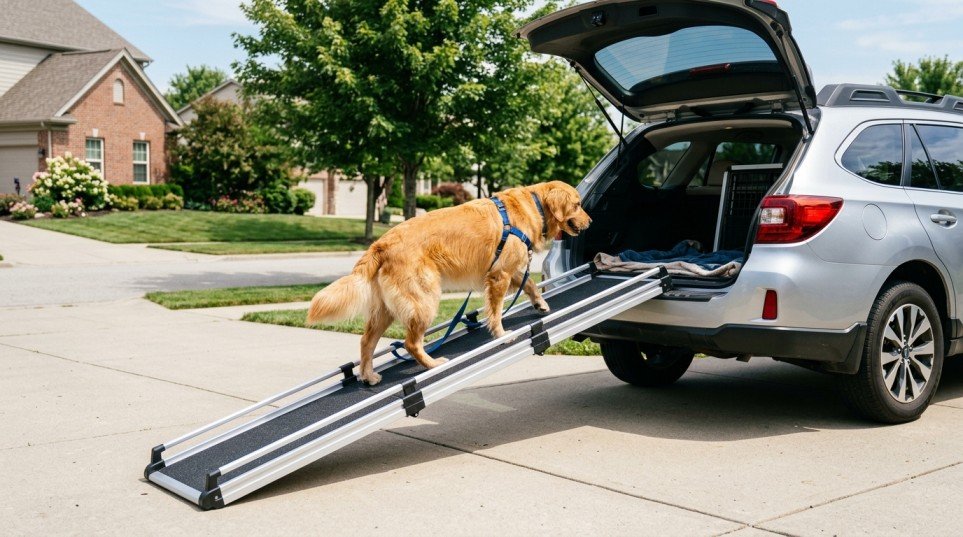
A ramp that is too short will create a steep angle that defeats its purpose. A ramp angled more than 20 to 25 degrees is difficult and uncomfortable for most dogs. Look for ramps that extend long enough to create a gentle slope for your specific vehicle.
2. Check the Weight Capacity
Every dog ramp has a published weight limit. Always choose a ramp rated for at least 20 to 25 percent more than your dog’s current weight. This gives a safety buffer for dynamic loading (when the dog is moving on the ramp, forces are higher than when standing still).
- Small dogs under 30 lbs: most ramps are adequate
- Medium dogs 30 to 70 lbs: verify the weight rating carefully
- Large dogs 70 to 120 lbs: choose ramps rated for 150 lbs or more
- Giant breeds over 120 lbs: use heavy-duty ramps rated 200 lbs or higher
3. Surface Traction Is Non-Negotiable
A ramp your dog slips on is worse than no ramp at all. Look for surfaces with:
- Rubberized grip strips or ribbed plastic
- Carpet-covered surfaces (good grip but harder to clean)
- Anti-slip side rails that keep your dog from veering off the edge
Avoid ramps with completely smooth plastic surfaces, especially for large dogs. Wet paws or rainy conditions amplify the slip risk significantly.
4. Consider Portability and Storage
Think about where the ramp lives when it is not in use:
- Telescoping ramps extend and collapse, making them easy to store in the trunk
- Bi-fold ramps fold in half and are very compact
- Tri-fold ramps fold into thirds and lie flat
- Single-piece ramps are durable but bulky
If you travel frequently or have limited trunk space, a folding or telescoping design will save you a lot of frustration.
5. Vehicle Attachment and Stability
A ramp that shifts while your dog is on it is a safety hazard. Look for ramps with:
- Rubber feet or non-slip pads on the bottom to grip the ground
- A lip or hook at the top that rests against the car’s bumper or door frame
- Side rails or raised edges to prevent dogs from stepping off the side
Dog Car Ramp Types at a Glance
| Ramp Type | Key Feature | Best For | Verdict |
| Telescoping | Adjustable length | Easy storage, car-friendly | Most popular choice |
| Folding | Folds flat | Compact, travel-ready | Great for small trunks |
| Ramp + Steps Combo | Stepped incline | Stability for large dogs | Best for heavy breeds |
| Portable Lightweight | Under 5 lbs | Easy to carry anywhere | Best for small dogs |
| Heavy Duty | Supports 200+ lbs | Built for large breeds | Long-term durability |
How to Train Your Dog to Use a Car Ramp
This is the part most guides skip over. Buying the right ramp is step one. Getting your dog to willingly walk up and down it is step two, and it takes patience.
Step 1: Introduce the Ramp on the Ground
Before the ramp ever goes near the car, let your dog investigate it at ground level. Place it flat on the floor and let them sniff it, walk over it, and stand on it at their own pace. Reward every interaction with high-value treats. This phase might take a single session or several days depending on your dog’s confidence level.
Step 2: Create a Slight Incline
Once your dog is comfortable walking over the flat ramp, prop one end up slightly on a step or low surface. Practice walking up and down the gentle slope. Keep sessions short, upbeat, and treat-heavy. Never force or push your dog.
Step 3: Introduce the Car
Position the ramp against the car at its full angle but with the car parked in a familiar location. Ask your dog to put their front paws on the ramp and reward immediately. Gradually work up to a full crossing, using treats placed along the ramp surface to encourage forward movement.
Step 4: Practice, Practice, Practice
Consistency builds confidence. Practice the ramp approach several times per week, even on days you are not going anywhere. Most dogs become fully comfortable within two to four weeks. Some anxious or older dogs may take longer, and that is completely normal.
Training Tip: Never rush a dog down the ramp. Let them come down at their own speed. A dog who feels pressured or loses balance on the descent may develop a lasting aversion to the ramp entirely.
Top Dog Ramp for Car: What to Look for by Category
Rather than recommending specific brands (which change stock, pricing, and quality frequently), here is what to look for in each category:
Best Overall Dog Car Ramp
- Telescoping design that extends to at least 62 inches for SUV height
- Traction surface with raised ribs or grip tape
- Side rails on both edges
- Weight rating of at least 150 lbs
- Rubber feet on both ends
Dog Car Ramp for Large Dogs
- Weight capacity of 200 lbs or more
- Wide walking surface of at least 16 to 18 inches
- Low-angle incline when extended (under 20 degrees for a 30-inch vehicle height, the ramp should extend at least 72 inches)
- Heavy rubber grip on the surface
Best Lightweight Dog Car Ramp for Small Dogs
- Under 6 lbs in total weight
- Compact fold for easy storage in any car
- Weight rating appropriate for your dog (even small ramps should not be flimsy)
- Surface texture that small paws can grip reliably
Best Dog Car Ramp for Trucks
- Extends to at least 72 to 84 inches for standard truck bed height
- Heavy-duty frame construction
- High weight rating
- Strong attachment mechanism for the truck bed lip
Common Dog Car Ramp Problems and How to Fix Them
My Dog Refuses to Use the Ramp
This is the most common issue and almost always comes down to rushing the training process. Go back to basics. Place the ramp on the floor and start over with the ground-level introduction phase. Some dogs need the approach broken into smaller steps, rewarding just for looking at the ramp, then touching it with one paw, then stepping on it with two paws.
The Ramp Slides on the Ground
Check whether the rubber feet are intact and making contact with the surface. Some ramps need additional grip tape added to the ground end. On smooth garage floors or pavement, placing a non-slip mat under the ramp’s base can help significantly.
My Dog Slips on the Ramp Surface
Add grip tape to the walking surface. Hardware store grip tape (the kind used on stairs) works well and adheres to most ramp materials. Alternatively, replace a smooth-surface ramp with one that has a carpet or rubberized surface.
The Ramp Is Too Steep for My Vehicle
You need a longer ramp. The only solution to an overly steep angle is a longer ramp or a ramp designed for taller vehicles. Do not try to adapt a short ramp to a tall vehicle by angling it more steeply. That defeats the purpose.
Dog Car Ramp Safety: What Every Owner Should Know
- Never leave a dog unattended on a ramp
- Check the ramp for stability before each use
- Inspect hinges and locking mechanisms regularly for wear
- Replace ramps with cracked, warped, or worn grip surfaces
- Guide your dog with a leash or hand signal when learning, but do not pull them up the ramp
- If your dog has had recent joint surgery, ask your vet when ramp use is appropriate and at what angle
A ramp that has visible structural damage is more dangerous than no ramp at all. Inspect your dog’s ramp every few months, especially if it is left outdoors or in the trunk where heat and moisture can cause deterioration.
Frequently Asked Questions: Dog Ramp for Car
What size dog ramp do I need for my car?
Measure your vehicle height from the ground to the loading surface. For most SUVs and crossovers at 24 to 30 inches, a ramp that extends to 60 to 70 inches will create a safe, low-angle incline. For trucks with bed heights of 30 to 36 inches, look for ramps extending to at least 72 to 84 inches.
Are dog ramps better than dog steps for getting into a car?
For dogs with joint problems, mobility limitations, or post-surgical recovery, ramps are almost always better than steps. Ramps provide a continuous incline without the need to judge step heights, which is easier on arthritic joints and less intimidating for anxious dogs. For healthy, agile small dogs, steps may work fine.
How do I get my dog to use a car ramp?
Introduce the ramp gradually using positive reinforcement. Start with the ramp flat on the ground, let your dog explore it, reward all contact with treats, and slowly increase the incline over multiple sessions. Most dogs learn to use a ramp comfortably within one to four weeks. Never force or rush the process.
What is the weight limit for dog car ramps?
Weight limits vary by ramp model. Most standard ramps support 150 to 175 lbs. Heavy-duty ramps for large and giant breeds are typically rated at 200 lbs or more. Always choose a ramp rated for at least 20 to 25 percent more than your dog’s current weight to allow a safety margin.
Can puppies use car ramps?
Yes, and it is actually recommended. Puppies, especially large and giant breed puppies, have developing growth plates that can be damaged by the repeated impact of jumping in and out of vehicles. Using a ramp from the start protects their joints during a critical developmental window and establishes a lifelong habit.
Is a dog ramp necessary for small dogs?
It depends on the vehicle and the dog’s age. A healthy young small dog getting into a low sedan may not need a ramp. But for small dogs loading into SUVs, trucks, or elevated vehicles, a ramp dramatically reduces the impact on their joints over time. Small breed dogs are also prone to intervertebral disc disease (IVDD), and avoiding repetitive jumping is a key prevention strategy recommended by veterinary neurologists.
How do I keep a dog ramp from sliding?
Look for ramps with rubber non-slip feet at both ends. Adding grip tape to the ground contact point or placing a non-slip mat underneath can further stabilize the ramp on smooth surfaces. Make sure the upper end of the ramp is securely resting against the vehicle bumper or door frame before your dog uses it.
Final Word: Is a Dog Car Ramp Worth It?
For dogs with joint problems, age-related mobility changes, or a history of orthopedic issues, a dog ramp for the car is not a luxury. It is a meaningful part of managing your dog’s long-term health and comfort.
Even for younger, healthier dogs, starting ramp use early prevents the cumulative wear that leads to early arthritis and expensive orthopedic surgeries down the road. The upfront cost of a good ramp is small compared to the veterinary bills and suffering that joint damage causes.
Choose a ramp that matches your vehicle height, suits your dog’s weight, has a surface your dog can grip confidently, and stores conveniently in your specific car. Train with patience and positive reinforcement. And once your dog gets it, the ramp will become as automatic as buckling your own seatbelt.
Sources and References
- American Kennel Club: Joint Health in Dogs. akc.org
- Merck Veterinary Manual: Canine Hip Dysplasia and Orthopedic Conditions. merckvetmanual.com
- American College of Veterinary Surgeons: Cranial Cruciate Ligament Disease. acvs.org
- Veterinary Evidence Journal: Intervertebral Disc Disease Prevention in Small Breeds. veterinaryevidence.org
- PetMD: How to Help a Dog with Arthritis. petmd.com
Discover More:-
- Can Dogs Eat Hot Dogs? A Complete Vet-Backed Guide 2026
- Fromm Dog Food Review 2026: Ingredients, Recalls, and Is It Worth It?

Dr. Ubaid Ur Rehman, DVM is a qualified veterinarian with expertise in pet health, nutrition, and preventive care. He is passionate about helping pet owners make informed decisions through accurate, research-based, and practical advice. As a veterinary professional, he reviews and contributes content to ensure reliable information for dog and pet owners.