20 Dog Facts That Will Change the Way You See Your Pet 2026
Quick Answer: Dogs have an estimated 300 million olfactory receptors compared to the human nose’s 6 million. Their brains are built for social bonding in ways that parallel human neurology. They dream, feel emotions, recognize faces, and communicate in dozens of ways most owners never notice.
You think you know your dog. You have lived together, shared a couch, and survived more than a few stolen sandwiches. But dogs are genuinely one of the most biologically fascinating animals on the planet, and most owners have barely scratched the surface of what makes them remarkable.
This guide covers 50 verified, science-backed dog facts across biology, behavior, senses, health, and history. Whether you are here for fun dog facts to share with your kids, weird dog facts you can use at trivia night, or genuinely useful information to understand your pet better, this is the complete, vet-informed resource.
Dogs are domesticated descendants of wolves that have evolved alongside humans for at least 15,000 years, possibly up to 40,000 years. In that time, they have developed biological and behavioral adaptations found in no other animal on Earth, including the ability to read human facial expressions and follow a pointed finger, which even chimpanzees cannot reliably do.
Dog Facts About Biology and the Body
1. Dogs Have Three Eyelids
Most people never notice a dog’s third eyelid, called the nictitating membrane. It sweeps horizontally across the eye from the inner corner and helps protect and lubricate the eye. When it becomes visible and stays exposed, it can signal illness or injury, a condition called cherry eye.
2. A Dog’s Nose Print Is Unique
The pattern of ridges and creases on a dog’s nose is as unique as a human fingerprint. The Canadian Kennel Club has accepted nose prints as a form of identification since 1938. Several companies now offer digital nose print registration as an alternative to microchipping.
3. Dogs Only Have Sweat Glands in Their Paws
Dogs do not sweat through their skin the way humans do. Their primary sweat glands, called merocrine glands, are located in the paw pads. This is why you might notice wet paw prints on a hot day or when a dog is anxious. Dogs regulate body temperature primarily through panting, not sweating.
4. A Dog’s Normal Body Temperature Is Higher Than Yours
The normal body temperature range for a healthy dog is 101 to 102.5 degrees Fahrenheit (38.3 to 39.2 Celsius), compared to the human average of 98.6 Fahrenheit. A temperature above 104 degrees Fahrenheit in a dog is a medical emergency. Below 99 degrees Fahrenheit also requires immediate veterinary attention.
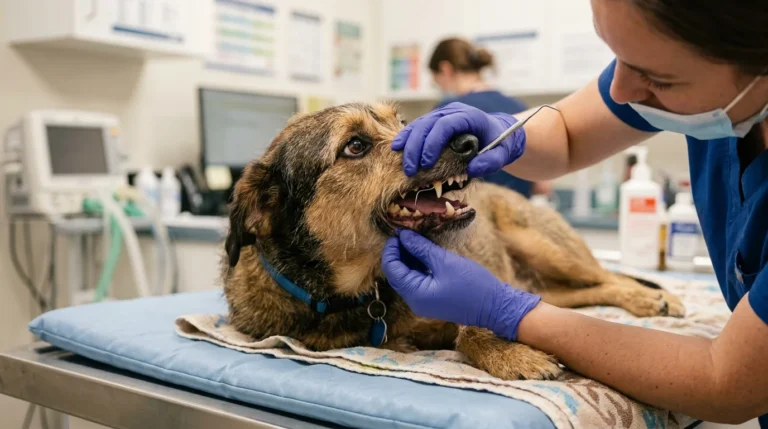
5. Dogs Have 42 Adult Teeth
Adult dogs have 42 permanent teeth, compared to the human adult count of 32. Puppies start with 28 baby teeth, which are typically replaced by adult teeth between four and seven months of age. Toy and small breeds frequently retain baby teeth, which requires veterinary extraction to prevent dental disease.
6. Dogs Are Digitigrade Walkers
Dogs walk on their toes, not on their full foot. This is called digitigrade locomotion. The raised structure at the back of a dog’s leg that looks like a backward knee is actually the heel. This toe-first walking style allows dogs to move faster and more quietly than flat-footed (plantigrade) animals like humans.
7. Their Whiskers Detect Air Current Changes
Whiskers, called vibrissae, are deeply embedded sensory tools, not just decorative hairs. They detect minute changes in air currents, which helps dogs navigate in the dark and detect nearby objects without touching them. Cutting a dog’s whiskers impairs its spatial awareness and should be avoided outside of show grooming requirements.
Dog Facts About the Senses
Understanding how dogs experience the world through their senses completely changes how you interpret their behavior. Here is a comparison of canine senses against human baselines.
| Dog Sense | Human Comparison | Real-World Ability | Fun Fact |
| Smell | 14x more olfactory receptors | Detect cancer, drugs, explosives | Can smell a teaspoon of sugar in a million gallons of water |
| Hearing | 4x the range of humans | Hear 65,000 Hz vs human 20,000 Hz | Can locate sound source in 1/600th of a second |
| Vision | Dichromatic (2 color types) | See blue and yellow clearly | Better night vision than humans |
| Taste | 1,700 taste buds vs human 9,000 | Less taste sensitivity overall | Have special receptors just for water |
| Touch | Whiskers detect air changes | Feel vibrations through paws | Born with fully developed touch sense |
8. A Dog Can Smell Up to 100,000 Times Better Than Humans
The commonly cited figure is that dogs smell 10,000 to 100,000 times better than humans, depending on the breed and the specific scent. This is driven by having up to 300 million olfactory receptors (humans have roughly 6 million) and a brain region dedicated to scent processing that is 40 times larger, proportionally, than the human equivalent.
9. Dogs Can Smell Time
Alexandra Horowitz, a dog cognition scientist at Columbia University, argues that dogs experience time through scent. The concentration of odor molecules in an environment decreases over time, which means a dog can essentially smell how long ago something happened. This may explain why dogs seem to know when their owner is about to come home.
10. Dogs Hear Frequencies Humans Cannot
Dogs can hear sounds in the range of 40 Hz to 65,000 Hz. The human hearing range is approximately 20 Hz to 20,000 Hz. This extended upper range is why dogs react to sounds that humans cannot perceive at all, including ultrasonic pest repellers, certain electronic devices, and distant sounds blocked from human awareness by background noise.
11. Dogs See Blue and Yellow Most Clearly
Dogs are not colorblind in the way the myth suggests. They are dichromats, meaning they have two types of color receptors compared to the human three. Dogs see blue and yellow clearly but cannot distinguish red from green. A red ball thrown onto green grass is difficult for a dog to track by color alone, which is one reason dogs rely heavily on movement to find toys.
12. Dogs Have a Special Organ for Scent-Taste
The Jacobson’s organ, or vomeronasal organ, sits in the roof of a dog’s mouth and connects to the brain via a pathway separate from the nose and taste buds. It is particularly sensitive to pheromones and large chemical molecules that carry social and reproductive information. When a dog curls its lip or opens its mouth near an interesting smell, it may be directing scent molecules toward this organ.
Dog Facts About Behavior and Intelligence
13. Dogs Understand Human Pointing
One of the most remarkable facts about dogs is that they can follow a human pointing gesture to find hidden objects. This seems trivially simple, but chimpanzees and wolves generally cannot do this reliably without extensive training. Dogs appear to have evolved this skill specifically through domestication, as a result of living with and depending on humans for thousands of years.
14. The Average Dog Has the Intelligence of a Two-Year-Old Human
Stanley Coren, a leading researcher in dog intelligence, estimates that the average dog can learn approximately 165 words, signals, and commands. The most intelligent breeds, including Border Collies, Poodles, and German Shepherds, can learn up to 250 words. Coren places this at roughly the cognitive level of a two-year-old child in terms of vocabulary and problem-solving.
15. Dogs Dream
Research from MIT and Harvard confirms that dogs enter REM sleep and experience dreams. The dreams appear to replay events from their day, similar to human dreaming. Small dogs dream more frequently than large dogs, but large dog dreams last longer. The twitching, paw paddling, and muffled sounds during sleep are direct expressions of dream activity, according to sleep researcher Matthew Wilson.
16. Dogs Experience Jealousy
A 2014 study published in PLOS ONE found that dogs show jealous behavior when their owners display affection toward other dogs or stuffed animals. Dogs pushed against their owners, tried to insert themselves between the owner and the other object, and in some cases snapped at the rival. Researchers considered this strong evidence that jealousy, previously thought to be a uniquely human social emotion, exists in dogs.
17. Dogs Use Yawning as Communication
Dogs yawn for reasons beyond tiredness. Yawning is a calming signal in dog body language, used to communicate that they are not a threat or to defuse tension in social situations. Dogs will also yawn in response to a human yawning, a behavior associated with empathy in social species. If your dog yawns during training or when greeted by a stranger, it is likely managing stress, not boredom.
18. Dogs Can Recognize Individual Human Faces
Research from Emory University using MRI technology found that dogs have a dedicated region in the visual cortex that responds to faces, similar to the fusiform face area in humans. Dogs can distinguish individual humans by face alone, even in photographs, and show stronger brain responses to familiar faces than to strangers.
19. Dogs Align With Earth’s Magnetic Field to Poop
A 2013 study published in Frontiers in Zoology found that dogs prefer to align their bodies along the north-south axis of Earth’s magnetic field when defecating, and avoid east-west orientation. The behavior was only observed during calm magnetic field conditions. While the researchers confirmed the pattern statistically across 70 dogs over two years, the reason for this preference remains unexplained.
Dog Facts About Health and Lifespan
20. Larger Dogs Age Faster Than Smaller Dogs
The relationship between body size and lifespan in dogs is the opposite of most mammals. In most species, larger animals live longer than smaller ones. In dogs, giant breeds like Great Danes have an average lifespan of 7 to 10 years, while small breeds like Chihuahuas routinely live 15 to 20 years. Researchers believe the accelerated growth rate required to reach large body sizes also accelerates the aging process at the cellular level.
21. Dogs Can Detect Cancer
Multiple peer-reviewed studies have documented trained dogs detecting lung cancer, breast cancer, colorectal cancer, and prostate cancer from breath, urine, or tissue samples with accuracy rates between 90 and 99 percent, sometimes outperforming standard clinical tests. The mechanism is that cancerous cells release volatile organic compounds with distinct odor profiles that fall within a dog’s detection range. Several research hospitals are actively working to identify the specific scent compounds for machine-based replication.
22. Dogs Can Smell Blood Sugar Changes
Diabetic alert dogs are trained to detect the scent of isoprene, a chemical produced when blood sugar falls below a safe level. Studies show accuracy rates of 80 to 90 percent for alerting before hypoglycemic episodes. The dog detects the change several minutes before standard glucometers would trigger an alarm, giving the owner time to respond. Some dogs appear to learn this ability without formal training, through extended exposure to diabetic owners.
23. Dogs Experience Separation Anxiety as a Clinical Condition
Separation anxiety in dogs is not a behavior problem or disobedience. It is a recognized anxiety disorder, treated by veterinary behaviorists with a combination of behavior modification protocols and, in moderate to severe cases, FDA-approved medications including fluoxetine and clomipramine. An estimated 14 to 20 percent of dogs are affected. The condition is significantly different from boredom-based destructive behavior, and misidentifying it leads to ineffective management.
24. A Dog’s Mouth Is Not Cleaner Than a Human’s
This is a persistent myth with no scientific basis. A dog’s mouth contains hundreds of bacterial species, many of which are unique to dogs and not transferable to humans under normal conditions. However, dogs that spend time outdoors carry soil bacteria, fecal bacteria from their own and other animals’ waste, and organisms from scavenging. Dog mouths are not uniquely clean or dirty by any meaningful measure.
Dog Facts About History and Domestication
25. Dogs Were the First Animal Domesticated by Humans
Current genetic and archaeological evidence points to dogs being domesticated from wolves between 15,000 and 40,000 years ago, well before any other animal. The exact location is debated, with evidence pointing to Central Asia, Europe, and the Middle East in different studies. What is consistent is that domestication predates the invention of agriculture by several thousand years, meaning dogs were with humans before we settled into farming communities.
26. Ancient Egyptians Mourned Dogs the Way They Mourned People
Archaeological evidence from ancient Egypt shows that dogs were mummified alongside their owners, buried in family tombs, and that family members would shave their eyebrows as a sign of mourning when a dog died. Egyptian papyri contain descriptions of dogs with individual names, specific personalities, and roles within the household that go well beyond working or utility animals.
27. There Were Dogs on the Titanic
At least twelve dogs were aboard the Titanic. Three of them survived, having been carried into lifeboats by their owners. The survivors were two Pomeranians and a Pekinese. The ship had a kennel in the forward part of the ship, and records show that several passengers walked their dogs on the deck on the evening of the sinking.
28. A Dog Has Served as Mayor
Bosco Ramos, a black Labrador-Rottweiler mix, was elected honorary mayor of Sunol, California in 1981 and served in the role until his death in 1994. The election was a joke that was taken seriously when Bosco defeated two human candidates. He appeared on Chinese state television after his victory when the town was mentioned in a broadcast about American democracy, reportedly causing confusion.
29. Dogs Have Served in Every Branch of the U.S. Military
Military working dogs have served in U.S. armed forces since World War I. In 2011, a Belgian Malinois named Cairo participated in the raid that located Osama bin Laden, accompanying Navy SEAL Team Six. Military dogs are trained for patrol, explosive detection, search and rescue, and in some cases, parachute and rappel operations. As of 2025, the U.S. military maintains approximately 1,600 active working dogs across all branches.
Interesting Dog Facts About Breeds
30. There Are Over 340 Recognized Dog Breeds
The Federation Cynologique Internationale (FCI), the largest international dog breed registry, recognizes 354 breeds as of 2025. The American Kennel Club recognizes 200. The difference largely reflects which breeds have sufficient global population and documentation for international recognition. All domestic dogs belong to the same species (Canis lupus familiaris), making them genetically compatible despite the massive variation in size, shape, and behavior between breeds.
31. The Basenji Is the Only Dog That Does Not Bark
The Basenji, a hunting dog originating from Central Africa, lacks the anatomical structure to produce a traditional bark. Instead, it produces a sound variously described as a yodel, chortle, or barroo. The Basenji is also one of the oldest known breeds and shares genetic markers with ancient Egyptian hunting dogs depicted in tomb paintings dated to around 3,000 BCE.
32. Greyhounds Are the Fastest Dogs on Earth
Greyhounds can reach speeds of 45 miles per hour, making them the fastest dog breed and one of the fastest land animals. A greyhound accelerates from 0 to 45 mph in approximately 30 feet. Interestingly, greyhounds are also known for being exceptionally calm and low-energy indoors. Despite their race-track reputation, they are often described by owners as the laziest dogs in the world once they are inside.
33. The Newfoundland Has Webbed Feet
Newfoundlands and several other breeds, including the Portuguese Water Dog and the Irish Water Spaniel, have webbed toes, where the skin between the toes extends further than in other breeds. This adaptation improves swimming efficiency. Newfoundlands were historically used to assist fishermen in Newfoundland, Canada, pulling nets and rescuing drowning sailors. Their thick, water-resistant double coat and powerful build made them exceptionally capable water rescue dogs.
34. Dalmatians Are Born Completely White
Dalmatian puppies are born entirely white and develop their characteristic spots over the first few weeks of life. The spots are determined by a genetic pattern that suppresses pigmentation in certain areas of the coat. Dalmatians that are born with spots already present have a different genetic condition that is associated with significant health problems. The breed also has an unusually high rate of hereditary deafness, affecting up to 30 percent of the population.
Weird Dog Facts Most People Have Never Heard
35. Dogs Can Fall in Love
When dogs interact with people they are bonded to, their brains release oxytocin, the same hormone associated with love and bonding in humans. Research from Azabu University in Japan found that when dogs and their owners make eye contact, both the dog’s and the owner’s oxytocin levels increase. This mutual oxytocin feedback loop is not observed between humans and wolves, even hand-raised wolves, suggesting it is a product of domestication.
36. Some Dogs Are Genetically Incapable of Aggression in Certain Situations
The Golden Retriever and Labrador Retriever were selectively bred over generations for what breeders call soft temperament, specifically including the suppression of bite-completion behavior. These breeds will often stop short of biting even when frightened or provoked. This is a genetic behavioral modification, not training, and it explains why both breeds have historically been favored for guide dog, therapy, and service roles.
37. Dogs Can Sniff and Breathe at the Same Time
Human nostrils are used for both smelling and breathing, which creates a conflict when you want to smell something carefully. Dogs have a flap of tissue inside the nose that directs airflow, allowing them to breathe through one pathway while directing scent molecules to the olfactory receptors through another. This lets dogs sniff continuously without interrupting respiration, which is essential for tasks like tracking.
38. The Chow Chow and Shar-Pei Have Blue-Black Tongues
Most dogs have pink tongues, but the Chow Chow and Chinese Shar-Pei are born with blue-black or spotted tongues due to an excess of pigment cells. The trait appears in no other domestic dog breed and in very few other species. In traditional Chinese culture, the dark tongue was considered a sign of good luck and spiritual protection.
39. Dogs Can Be Left-Pawed or Right-Pawed
Research from the University of Manchester found that approximately 50 percent of dogs show a clear preference for one paw over the other when reaching for objects or stepping over barriers, similar to human handedness. Left-pawed dogs show higher levels of pessimistic thinking in decision-making tests and higher stress in novel situations, while right-pawed dogs perform more consistently in training tasks.
40. A Dog’s Paw Pads Smell Like Corn Chips
The distinctive corn chip or Fritos scent that many owners notice coming from their dog’s paws is caused by naturally occurring yeast and bacteria, specifically Proteus and Pseudomonas species, that thrive in the warm, moist environment between the paw pads. It is completely normal and not a sign of infection unless it is accompanied by redness, discharge, or the dog excessively licking its paws.
Fun Dog Facts for Kids
These facts are perfect for school projects, trivia games, or just impressing your friends.
- Dogs have been in space. A Soviet dog named Laika became the first living creature to orbit Earth in 1957.
- The tallest dog ever recorded was a Great Dane named Zeus, who measured 44 inches at the shoulder (that is taller than most seven-year-olds).
- The heaviest dog breed is the Saint Bernard, which can weigh up to 180 pounds. The lightest is the Chihuahua, which can weigh as little as 2 pounds.
- Dogs have been to the moon. Well, not quite, but the first animals sent to space included Laika, and the Soviet program also sent dogs named Belka and Strelka, who returned safely.
- A dog named Endal was awarded the PDSA Gold Medal for gallantry and devotion to duty. He could operate a cash machine, ride escalators, and load and unload a washing machine.
- The oldest dog ever recorded was an Australian Cattle Dog named Bluey, who lived to be 29 years and 5 months old.
- Dogs were used to carry messages in World War I, sometimes under heavy fire. A dog named Rags delivered messages in the Battle of the Argonne Forest.
- There is a dog in Japan named Hachiko who waited at a train station every day for his deceased owner for nearly 10 years. A statue in his honor still stands at the station.
Frequently Asked Questions: Dog Facts
How many dog breeds are there in the world?
The FCI recognizes 354 officially registered breeds as of 2025. The total number of distinct dog breeds, including those not yet formally recognized, is estimated to be between 400 and 450 worldwide.
What is the smartest dog breed?
According to Stanley Coren’s rankings in The Intelligence of Dogs, the Border Collie holds the top position, followed by the Poodle and the German Shepherd. Intelligence in dogs is measured across three dimensions: instinctive intelligence (what the breed was developed to do), adaptive intelligence (problem-solving), and working and obedience intelligence (learning from humans).
Can dogs really smell cancer?
Yes. Multiple peer-reviewed studies confirm that trained dogs can detect various cancers from breath and urine samples with very high accuracy. The research is ongoing, with several hospitals actively using dogs in cancer detection research programs. Researchers are working to identify the specific volatile compounds dogs are detecting so the ability can be replicated in electronic form.
Do dogs feel love?
The neuroscience supports it. Dogs release oxytocin during positive interactions with bonded humans, the same hormone associated with love and attachment in people. Brain scan research by neuroscientist Gregory Berns at Emory University found that dogs respond to the scent of their owner in the reward center of the brain, the same region activated by pleasurable experiences. Whether dogs experience love as humans understand it philosophically is debated, but the neurological underpinnings are real.
What is the oldest dog breed?
The Basenji, Saluki, Afghan Hound, and Siberian Husky are consistently cited among the oldest breeds based on genetic analysis. The Basenji in particular shares genetic markers with ancient Egyptian hunting dogs dated to approximately 3,000 BCE. However, determining the single oldest breed depends on how breed identity is defined genetically versus historically.
Why do dogs spin before lying down?
The circling behavior before lying down is a vestigial survival instinct inherited from wild canine ancestors. In the wild, circling before resting served to pat down grass, check for snakes or insects, and position the dog relative to wind direction for scent detection. Modern dogs retain the behavior even on perfectly comfortable beds where none of these concerns apply.
Can dogs tell time?
Dogs do not read clocks, but they track time through multiple systems including circadian rhythms, scent concentration changes in their environment, and routine. Research and owner reports consistently show that many dogs anticipate their owner’s return within a narrow time window, seemingly aware that a normal workday has elapsed. Alexandra Horowitz’s research on olfactory time perception provides a plausible mechanism for this ability.
Final Word: Why Dog Facts Matter Beyond Trivia
These facts are not just interesting conversation starters. Understanding how dogs experience the world helps you become a better owner. Knowing that your dog smells time helps explain the elaborate greeting rituals. Know that dogs use yawning to manage stress helps you avoid misreading anxiety as noncompliance. Knowing that dogs dream makes those sleeping twitches meaningful rather than worrying.
Dogs have co-evolved with humans longer than any other animal. The bond is biological, not just emotional. And the more you understand the science behind it, the more you can genuinely meet your dog where they are.
If you found one fact here that changed how you see your dog, that is what this was for.
Sources and References
- Merck Veterinary Manual: Canine Anatomy and Physiology. merckvetmanual.com
- American Kennel Club: Dog Breed Intelligence Rankings. akc.org
- Coren, Stanley. The Intelligence of Dogs. Free Press, 2006.
- Horowitz, Alexandra. Being a Dog. Scribner, 2016.
- Berns, Gregory. How Dogs Love Us. New Harvest, 2013.
- PLOS ONE: Jealousy in Dogs. journals.plos.org, 2014.
- Frontiers in Zoology: Magnetic Alignment in Dogs. frontierszool.biomedcentral.com, 2013.
- Journal of Veterinary Behavior: Separation Anxiety in Dogs. journals.elsevier.com
- ASPCA Animal Poison Control Center. aspca.org
- Federation Cynologique Internationale: Breed Standards. fci.be
Discover More:-
- Fromm Dog Food Review 2026: Ingredients, Recalls, and Is It Worth It?
- High Protein Dog Food: A Complete Vet-Backed Guide 2026

Dr. Ubaid Ur Rehman, DVM is a qualified veterinarian with expertise in pet health, nutrition, and preventive care. He is passionate about helping pet owners make informed decisions through accurate, research-based, and practical advice. As a veterinary professional, he reviews and contributes content to ensure reliable information for dog and pet owners.