
Dog Trainers for Resource Guarding: How to Find the Right Expert 2026
Your dog growls when you approach their food bowl. They snap when you reach for their favorite toy. Maybe they have already bitten someone. Before you assume your dog is aggressive or broken, take a breath. Resource guarding is one of the most misunderstood behaviors in dogs, and it is also one of the most successfully treated when you work with the right professional.
This guide covers everything you need to know about finding and working with dog trainers for resource guarding: what qualifications actually matter, how to identify a trainer who will not make the problem worse, what real treatment looks like, and when you need a veterinary behaviorist instead of a trainer.
What Is Resource Guarding in Dogs?
Resource guarding is a normal canine behavior in which a dog uses threatening signals, including stiffening, growling, snapping, or biting, to prevent another person or animal from taking something they value. Common guarded resources include:
- Food bowls, bones, and high-value chews
- Toys and stolen items
- Resting spots like beds, couches, and crates
- Their owner or a specific family member
- Territory near doorways or under furniture
Resource guarding exists on a spectrum. Some dogs freeze briefly when approached. Others growl consistently. A smaller number escalate to snapping or biting. The behavior is rooted in evolutionary survival instincts and is not a sign that your dog is dominant, spiteful, or defective. It is, however, a safety concern that becomes more dangerous when handled incorrectly.
Important: Punishing resource guarding, whether through yelling, physical corrections, or alpha rolls, consistently makes the behavior worse. It does not teach the dog to feel differently about the situation. It teaches them that warning signs are unsafe, and they skip directly to biting.
Do You Need a Dog Trainer or a Veterinary Behaviorist?
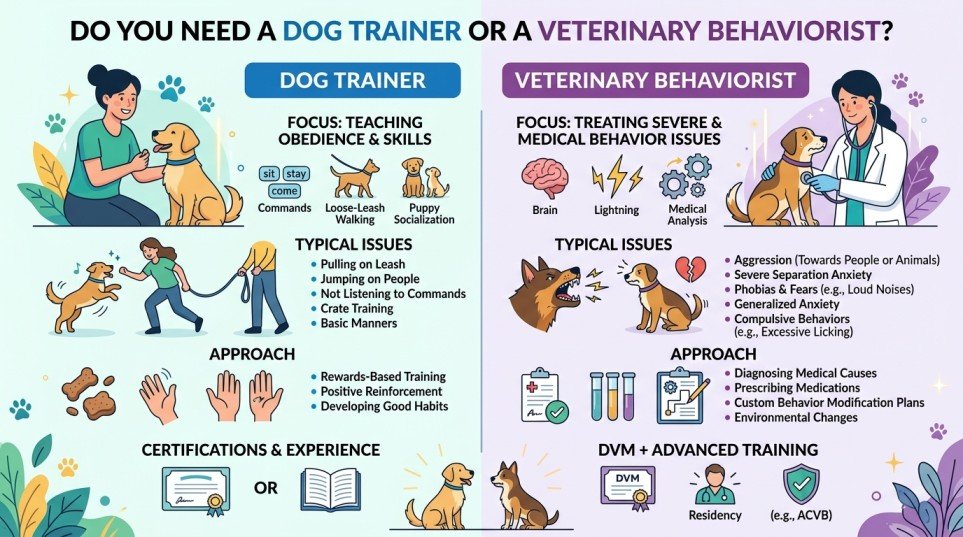
This is the most important question to answer before you start searching. Not all resource guarding cases are suitable for a standard dog trainer, even a highly qualified one.
When a Qualified Dog Trainer or Behavior Consultant Is Appropriate
A skilled trainer or Certified Dog Behavior Consultant (CDBC) can effectively address most resource guarding cases if:
- The dog uses warnings (growling, stiffening) but has not yet bitten
- Any bites have been minor, single-incident, and clearly context-specific
- The dog’s history is known and there are no other significant aggression concerns
- There are no children under 5 in the household or the dog’s access to them is well-managed
When You Need a Veterinary Behaviorist
Skip the trainer search and go directly to a board-certified veterinary behaviorist (Diplomate ACVB) if:
- Your dog has bitten multiple times or caused injuries requiring medical attention
- The guarding behavior appeared suddenly in an adult dog with no history of it
- You suspect a medical cause such as pain, thyroid dysfunction, or neurological changes
- The dog guards unpredictably, with no consistent pattern or trigger
- There are infants or toddlers in the home
- Other trainers have attempted intervention without improvement
A veterinary behaviorist is a licensed veterinarian with a residency specialization in animal behavior. They can prescribe medication as part of the treatment plan, which is often essential for severe guarding cases. No dog trainer, regardless of credentials, can do this.
What Qualifications Should Dog Trainers for Resource Guarding Have?
The dog training industry in the United States is entirely unregulated. Anyone can call themselves a dog trainer, print business cards, and charge for sessions with zero formal education or accountability. This makes credential checking essential, especially for a behavior as serious as resource guarding.
Here is what to look for and what it actually means:
Credentials That Matter
| Credential | Issuing Body | What It Requires | Suitable For Guarding? |
| CDBC | IAABC | 500+ hours, case study, exam | Yes, most cases |
| CAAB / ACAAB | ABAI | Graduate degree + 5 yrs supervised work | Yes, complex cases |
| CPDT-KA | CCPDT | 300 hours + knowledge exam | Mild to moderate cases |
| Dip ACVB | ACVB | Vet degree + behavior residency | Severe or medical cases |
Credentials and Titles That Are Not Meaningful
- Pack leader or alpha trainer certifications from private organizations
- Cesar Millan-style dominance-based certifications with no peer-reviewed methodology
- Self-issued titles like Master Dog Trainer or Canine Behavior Expert
- Certifications from online courses with no supervised practicum hours
Why Training Methodology Matters More Than Almost Anything Else
When it comes to resource guarding, the method your trainer uses is not a preference. It is a safety question. The wrong methodology can escalate a dog from growling to biting within weeks.
Evidence-Based Methods That Work for Resource Guarding
Desensitization and Counter-Conditioning (DS/CC): This is the gold standard for resource guarding. The trainer systematically changes how the dog feels about an approach to their resource, using controlled exposures paired with highly desirable outcomes. Done correctly, the dog learns that your approach predicts something better than what they are guarding.
Trade-Up Training: Teaching the dog to voluntarily give up items in exchange for something of higher value. This addresses the practical day-to-day management challenge while the underlying emotional response is modified through DS/CC.
Relaxation Protocols: Structured exercises, such as Dr. Karen Overall’s Relaxation Protocol, that teach the dog to remain calm and offer deference behaviors in low-arousal contexts before gradually introducing more challenging situations.
Methods That Make Resource Guarding Worse
- Alpha rolls or forced submission positions
- Taking food or items away repeatedly to teach the dog to accept it
- Punishing growling (this removes the warning signal without addressing the cause)
- Flooding: forcing the dog to remain in the presence of the triggering situation until they give up
- Dominance theory-based corrections, including e-collars used for aggression suppression
The research is consistent: a 2009 study published in Applied Animal Behaviour Science by Herron, Shofer, and Reisner found that confrontational training methods produced aggressive responses in 25 to 43 percent of dogs studied. For resource guarding cases specifically, aversive methods reliably suppress warning signals and increase bite risk.
How to Find Dog Trainers for Resource Guarding Near You
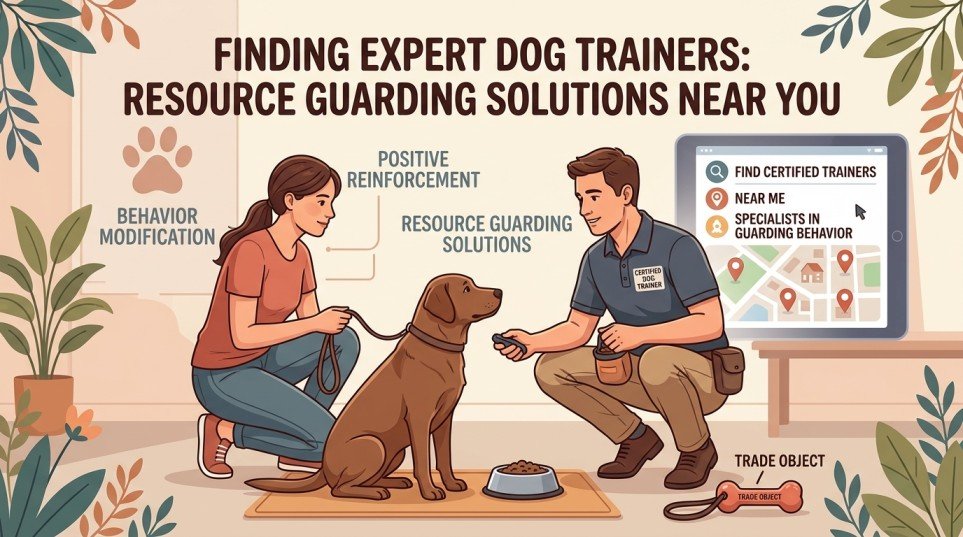
There is no single national registry for all qualified trainers, but several organizations maintain searchable directories of certified professionals. Use these first:
Best Directories to Search
- IAABC Trainer Directory (iaabc.org/referral): Filters by specialty including aggression and resource guarding. Prioritize CDBC and CAAB holders.
- CCPDT Trainer Search (ccpdt.org): Find CPDT-KA or CPDT-KSA certified trainers by zip code. Useful for mild to moderate cases.
- ACVB Find a Diplomate (dacvb.org): For severe cases or when medication may be needed. Board-certified veterinary behaviorists only.
- Veterinary Referral: Your regular vet may have working relationships with local behavior specialists and can provide a direct referral rather than a cold search.
Questions to Ask Before You Book
Once you have identified a candidate, ask these questions directly. How they answer matters as much as the answers themselves:
- What is your specific training methodology for resource guarding?
- What credentials do you hold and from which organizations?
- How many resource guarding cases have you worked with in the past 12 months?
- Do you use any aversive tools including prong collars, e-collars, or choke chains?
- Under what circumstances would you refer a case to a veterinary behaviorist?
- Do you offer a written behavior modification plan I can follow between sessions?
A trainer who cannot clearly explain their methodology, who dismisses the question about aversives, or who promises to fix the problem quickly should be approached with caution. Resource guarding modification takes time. Anyone claiming otherwise is either inexperienced or oversimplifying.
What Resource Guarding Training Actually Looks Like
Understanding the process helps you evaluate whether what a trainer is proposing is appropriate, and whether the timeline they are offering is realistic.
Initial Assessment
A qualified trainer will begin with a detailed history intake before any training starts. They will want to know:
- What triggers the guarding behavior and in what sequence
- The dog’s full bite history, including any near-misses
- Current management strategies in the home
- Who lives in the household and how much direct exposure they have to the dog during guarding episodes
- Any previous training attempts and their outcomes
Do not work with a trainer who skips this step and moves directly to handling the dog. Assessment is non-negotiable.
Phase 1: Management and Safety
Before any behavior modification begins, the trainer will help you implement management strategies to prevent rehearsal of the guarding behavior. This typically includes:
- Feeding the dog in a separate room or behind a baby gate
- Removing high-value items from common areas
- Identifying and controlling access to guarded spaces
- Teaching all household members a consistent response protocol when guarding occurs
Phase 2: Counter-Conditioning Work
The trainer will systematically work below the threshold where the dog shows any stress signals. This means starting at a distance the dog is completely comfortable with, pairing the trainer or owner’s approach with extremely high-value reinforcement, and only advancing when the dog is showing relaxed, positive anticipation rather than tension.
This phase is often slower than owners expect. Progress is measured in how the dog feels, not just what they do. A dog that tolerates your approach but remains tense is not ready to advance.
Phase 3: Generalization
Once the dog is reliably comfortable with approach to guarded resources in a training context, the work generalizes to real-world scenarios, different locations, different people, and different resources. This is also where trade-up exercises and voluntary release training are integrated into daily life.
Resource Guarding Risk by Scenario: Quick Reference Table
| Scenario | Risk Level | Immediate Step | Recommended Professional |
| Dog stiffens but no growl | Low | Begin management | Qualified trainer or CDBC |
| Consistent growling over food | Moderate | Management + trainer | CDBC or CPDT-KA |
| Snapping without contact | Moderate-High | Strict management | CDBC or CAAB |
| Single bite, minor injury | High | Restrict access | CDBC or veterinary behaviorist |
| Multiple bites or injury | Severe | Emergency management | Veterinary behaviorist (ACVB) |
| Sudden onset in adult dog | Severe | Vet check first | Veterinarian + ACVB |
How Much Does a Resource Guarding Trainer Cost?
Pricing varies significantly by location, credentials, and the format of training offered. Here is a realistic breakdown as of 2025:
- Initial behavior assessment (60 to 90 minutes): $150 to $350
- Private training sessions (45 to 60 minutes): $100 to $250 per session
- Multi-session behavior modification package (6 to 10 sessions): $600 to $2,000
- Veterinary behaviorist consultation: $250 to $500 for the initial appointment
- Board-certified behaviorist follow-up sessions: $150 to $300 each
If cost is a barrier, contact local humane societies and animal shelters. Many have behavior departments that offer subsidized training for surrender-risk cases, and some university veterinary programs offer behavior clinics at reduced rates.
Note: Be cautious of board and train programs that advertise resource guarding fixes. These residential programs remove the dog from the context where the guarding occurs, which limits how well skills transfer back to the home environment. Always ask how they plan to address generalization before enrolling.
Can You Train Resource Guarding at Home Without a Trainer?
For very mild cases, some structured at-home work can be effective. Jean Donaldson’s book Mine! A Practical Guide to Resource Guarding in Dogs is widely recommended by behavior professionals and outlines a structured DS/CC protocol that informed owners can follow safely.
However, at-home work is not appropriate if:
- The dog has bitten or snapped at a person
- You are unsure how to read your dog’s stress signals accurately
- There are children in the household
- The behavior is escalating or is unpredictable
Even owners who attempt at-home work benefit from at least one professional consultation to confirm they are reading the dog correctly and advancing at the right pace.
Frequently Asked Questions: Dog Trainers for Resource Guarding
Can resource guarding be cured?
Resource guarding can be significantly reduced and safely managed in the vast majority of dogs. The word cure implies the underlying instinct is erased, which is not accurate. What treatment achieves is a reliable change in how the dog feels about an approach, so the behavior becomes unnecessary from their perspective. Owners also learn management skills that prevent situations from escalating. Most dogs treated by qualified professionals show lasting improvement.
How long does resource guarding training take?
Mild to moderate cases typically show meaningful improvement within 8 to 16 weeks of consistent structured work. Severe cases, especially those involving biting history or multiple guarded resources, can take 6 months or longer. Timeline depends on the dog’s history, the consistency of the owner’s follow-through between sessions, and whether medication is part of the plan.
Is resource guarding dangerous?
Resource guarding becomes dangerous when warning signals are suppressed through punishment, when the dog escalates without intervention, or when there are young children or other dogs in the home who cannot reliably read the dog’s signals. Managed correctly and treated with appropriate professional help, most resource guarding dogs live safely with their families.
Should I punish my dog for resource guarding?
No. Punishing resource guarding is consistently shown to make the behavior more dangerous, not less. When a dog is punished for growling, they often stop growling and bite instead, because the situation that made them uncomfortable has not changed, only their ability to warn has been suppressed. Address the cause, not the symptom.
What is the difference between a dog trainer and a veterinary behaviorist?
A dog trainer, even a highly credentialed one, is not a veterinarian and cannot prescribe medication or diagnose underlying medical conditions. A veterinary behaviorist holds a veterinary degree plus a board-certified residency in animal behavior. They are the appropriate choice for severe aggression cases, sudden onset behavior changes, and cases where medication is likely to be part of the treatment plan.
Can resource guarding be trained out of puppies?
Early intervention is strongly encouraged. Puppies can be taught that having humans approach their food and resources is a positive experience, which prevents resource guarding from developing into a problem behavior. This is not achieved by taking food away repeatedly, which often creates guarding where none existed. It is achieved through food bowl approach protocols that pair your presence with additional food being added.
What if my dog guards from other dogs, not people?
Inter-dog resource guarding is common in multi-dog households and is typically addressed through management, supervised feeding arrangements, and in some cases, behavior modification under professional guidance. It does not automatically indicate the dog is dangerous to people, but it does require a structured management plan to prevent conflict and injury between pets.
Final Word: Finding the Right Help for Your Resource Guarding Dog
Resource guarding is treatable. It is not a life sentence for your dog or your household, but it does require the right professional, the right methodology, and a realistic commitment from you.
Start by being honest about where your dog falls on the severity spectrum. If there has been any bite history, start with a veterinary behaviorist or at minimum a Certified Dog Behavior Consultant before attempting any at-home work. Check credentials using the IAABC and CCPDT directories. Ask direct questions about methodology and walk away from anyone who relies on dominance or correction-based approaches.
When you find the right trainer, expect a structured plan, a realistic timeline, and a clear explanation of what you will be doing between sessions. The goal is not just a dog who tolerates your presence near their bowl. It is a dog who genuinely looks forward to it.
Sources and References
- International Association of Animal Behavior Consultants (IAABC): Resource Guarding Guidelines. iaabc.org
- American College of Veterinary Behaviorists (ACVB): Find a Diplomate Directory. dacvb.org
- Herron, M.E., Shofer, F.S., Reisner, I.R. (2009). Survey of the use and outcome of confrontational and non-confrontational training methods in client-owned dogs showing undesired behaviors. Applied Animal Behaviour Science, 117(1-2), 47-54.
- Donaldson, J. Mine! A Practical Guide to Resource Guarding in Dogs. Dogwise Publishing.
- Overall, K.L. Clinical Behavioral Medicine for Small Animals. Mosby, 1997.
- CCPDT Certified Professional Dog Trainer Directory. ccpdt.org
- Certified Applied Animal Behaviorist Directory. animalbehaviorsociety.org