Dog Cage in Car: Everything You Need for Safe Travel 2026
Quick Answer: A crash-tested, properly sized crate that is secured to the car structure is the gold standard for dog travel safety. Unsecured crates, soft-sided bags, and loose dogs in the backseat are all significantly more dangerous. A car harness is a valid alternative but not a replacement for a crate in high-speed travel.
You are about to load your dog into the car for a road trip. You know a loose dog in the backseat is not safe, but you are not sure whether a cage is the right solution, which type to get, or how to set it up correctly. This guide gives you the complete, research-backed picture.
We cover every question dog owners actually search for: whether a dog cage in a car is necessary, which crate types are safest in a crash, how to size one correctly, where to position it, and what to do if your dog hates being crated in the car.
Dog Cage in Car: The Short Answer
Using a dog cage or crate in a car is one of the safest ways to transport your dog. A properly secured crate protects your dog in a crash, prevents driver distraction, and gives your dog a calm, familiar space during travel.
The debate exists because many dog owners use seat belt harnesses or cargo barriers instead of cages. These options offer some protection but come with important limitations. The safest choice depends on your dog’s size, your vehicle type, and how far you are traveling.
Why Use a Dog Cage in a Car?
1. Crash Protection
In a collision at 35 mph, an unrestrained 60-pound dog becomes a 2,700-pound projectile inside the vehicle. That is not a figure of speech. It is the result of basic physics: force equals mass times acceleration. An unrestrained dog in a crash can kill both itself and the human passengers it strikes.
Important: A crate absorbs and distributes crash forces much more effectively than a harness alone, especially in side-impact and rollover crashes. For this reason, crash-tested crates are recommended by the Center for Pet Safety and many veterinary safety researchers.
2. Driver Distraction
A loose dog in a car is a major distraction. Studies on driver behavior have found that pets moving freely in a vehicle increase reaction times and lane deviation comparably to using a handheld phone. A crate eliminates this risk entirely by giving your dog a contained, secure space.
3. Dog Anxiety and Behavior
Many dogs feel more secure in a crate during car travel, especially if they have been crate trained from a young age. A crate that smells like home, has a familiar blanket, and gives the dog a sense of boundaries is often calming. Dogs that pace, whine, or drool excessively in the car frequently do better with a properly introduced crate.
4. Post-Accident Containment
If your car is in an accident and a door or window breaks open, a crated dog stays contained. A loose dog will often bolt in a panic directly into traffic. Emergency responders also report that a crated dog is much safer and easier to manage at a crash scene.
Types of Dog Cages for Car Travel
| Type | Crash Safety | Best For | Verdict |
| Crash-tested hard crate | Excellent | All dogs, high-speed travel | Best overall safety |
| Standard wire crate | Moderate | SUVs, short trips | Secure but not crash-tested |
| Soft-sided crate | Low | Very small, calm dogs | Portable, not impact-safe |
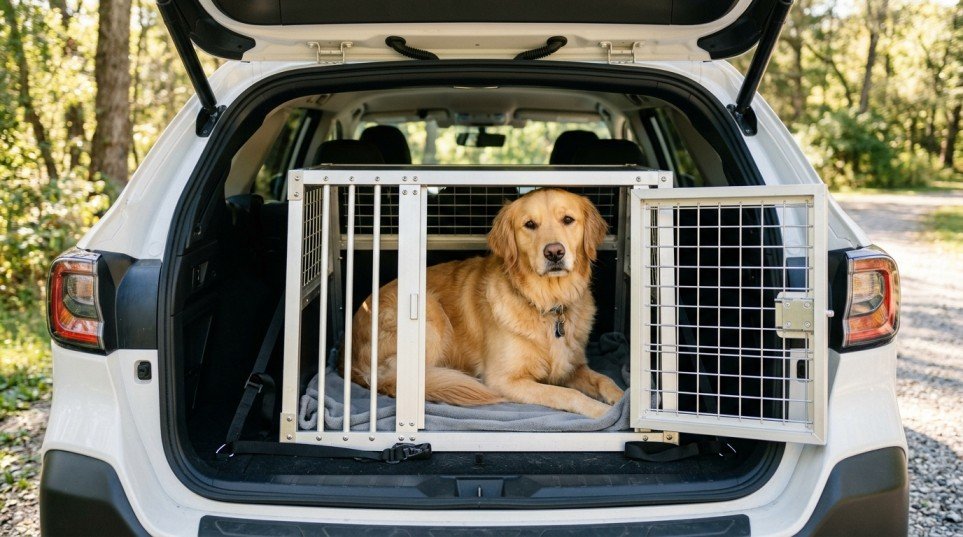
| Aluminum/metal travel crate | High | Large breeds, SUV cargo areas | Heavy but very strong |
| Dog travel bag (carrier) | Very Low | Cats, tiny dogs only | Not suitable for car travel |
| Booster seat with tether | Low | Small dogs wanting a view | Distraction risk remains |
How to Size a Dog Cage for Your Car
Sizing a dog crate for car travel involves two measurements: your dog’s body and your vehicle’s available space. Getting both right matters equally.
Measuring Your Dog
- Length: Measure from the tip of the nose to the base of the tail (not including the tail). Add 4 inches.
- Height: Measure from the floor to the top of the head or the tips of the ears, whichever is taller. Add 4 inches.
- Width: Your dog should be able to turn around comfortably. Width equal to the dog’s shoulder width plus 2 inches on each side is a good starting point.
Sizing by Breed Weight
- Under 10 lbs (e.g., Chihuahua, Toy Poodle): Small crate, approximately 18 to 22 inches long
- 10 to 25 lbs (e.g., French Bulldog, Shih Tzu): Medium crate, approximately 24 to 30 inches long
- 25 to 50 lbs (e.g., Beagle, Cocker Spaniel): Intermediate crate, approximately 30 to 36 inches long
- 50 to 90 lbs (e.g., Labrador, Golden Retriever): Large crate, approximately 36 to 42 inches long
- Over 90 lbs (e.g., Great Dane, Saint Bernard): Extra-large crate, 48 inches or custom
A crate that is too large is not safer. If the crate allows the dog to be thrown forward inside it during braking, the dog can still be injured. A snug but comfortable fit reduces internal movement in a crash.
Where to Put the Dog Cage in a Car
Placement matters as much as the crate itself. The safest and least safe positions in a car are not where most people assume.
Cargo Area of an SUV or Wagon
This is the ideal location for most medium and large dogs. The cargo area allows the crate to be pushed against the back of the rear seat and secured with cargo straps looped through the seatbelt anchors or anchor points. The rear crumple zone absorbs energy in a rear-end collision before it reaches this area.
Back Seat of a Sedan
A crate on the back seat can work for smaller crates if the seat belt is looped through the crate’s top handle and the crate sits flush against the seat back. The crate should not be able to slide forward toward the front seats.
Front Passenger Seat
Do not place a dog crate on the front passenger seat if the airbag cannot be disabled. A front airbag deploying into a crate can injure or kill a dog. If you must use the front seat, disable the passenger airbag first.
Truck Bed
Never transport a dog in an open truck bed, crated or not. In a crash or sudden stop, even a secured crate can be ejected. In most U.S. states, transporting a dog in an open truck bed is illegal if the dog is not restrained by a cross-tether system.
How to Secure a Dog Cage in a Car
An unsecured crate in a car is almost as dangerous as no crate at all. In a 35 mph frontal collision, an unsecured 50-pound metal crate becomes a 2,250-pound missile in the vehicle cabin. Proper securement is non-negotiable.
Step 1: Choose the Right Anchor Points
- Cargo area: Use the built-in tie-down anchors in the floor of the cargo area. These are designed to secure loads.
- Back seat: Use the LATCH anchor system or loop a cargo strap through the headrest posts.
- Never use bungee cords as primary restraints. They stretch and allow crate movement.
Step 2: Use Rated Cargo Straps
Use ratchet-style cargo straps with a weight rating at least three times the combined weight of the crate and dog. Run straps over the top of the crate from front to rear anchor points, and optionally from side to side if your vehicle has side anchor points.
Step 3: Test Before Driving
Push the crate firmly from the front, back, and sides. It should not shift more than one inch in any direction. If it moves more than that, tighten the straps or add additional tie points.
Step 4: Consider a Purpose-Built Vehicle Insert
Some manufacturers make dog crate inserts designed specifically for cargo areas of popular SUV and truck models. These slide-in systems lock to the vehicle floor and eliminate the need for straps entirely. They are the most secure option available.
What If My Dog Hates the Car Crate?
This is one of the most searched questions from dog owners, and the answer depends on what kind of distress your dog is showing and whether they are crate trained at all.
Step 1: Separate Crate Anxiety from Car Anxiety
Some dogs are fine in a crate at home but stressed in the car. Others dislike the crate itself. Identifying which is happening helps you choose the right solution.
- Dog refuses to enter the crate: Likely needs more crate training. Start with the crate in the house, feed meals inside it, and build positive associations gradually.
- Dog enters the crate but panics in the car: This is car anxiety, not crate anxiety. Work on desensitization to car movement (see below).
- Dog vomits or drools heavily: This is likely motion sickness. Talk to your vet about anti-nausea medications like maropitant (Cerenia) before assuming it is behavioral.
Step 2: Desensitization Protocol
If your dog has car anxiety, do not force the issue by taking long trips. Use this graduated approach:
- Place the crate in the parked car with the door open and treats inside. Do not close the crate. Let the dog explore at will.
- Close the crate while the car remains parked. Stay in the car. Give treats through the crate door.
- Start the engine while the dog is in the crate. Do not drive. Give treats and calm praise.
- Take a very short drive, one minute or less, then return home and release the dog with a reward.
- Gradually increase trip duration over days and weeks.
Most dogs will habituate to crate travel within two to four weeks with this approach. Dogs that show extreme distress (self-injury, panic attacks, complete refusal to eat) should be evaluated by a veterinary behaviorist before continued travel attempts.
Legal Requirements for Dog Cages in Cars
Dog restraint laws in cars vary significantly by country and, in the United States, by state. Here is what you need to know:
United States
- New Jersey is the only U.S. state with an explicit law requiring dogs to be restrained in vehicles. Violations can result in fines under animal cruelty statutes.
- Hawaii and a handful of other states have laws prohibiting dogs on the driver’s lap.
- Many states have general distracted driving laws that could technically apply to an unrestrained dog.
- Truck bed transport of unrestrained dogs is illegal in California, Connecticut, Maine, Massachusetts, and several other states.
United Kingdom
The Highway Code in the UK requires that animals be suitably restrained so they cannot distract the driver or injure themselves or others in an emergency stop. Failure to comply can result in a fine or penalty points on your license.
Australia
Several Australian states and territories require dogs to be restrained in vehicles. In New South Wales, a dog riding in a vehicle tray must be secured by a proper restraint. Rules vary by state, so check your local transport authority.
What Makes a Dog Crate Crash-Tested?
The term crash-tested is not regulated, which means any company can technically use it. Knowing how to identify genuinely tested crates protects your dog and your wallet.
The Center for Pet Safety (CPS) is the only independent organization in the United States that conducts standardized crash testing of pet restraints using FMVSS 213 (child safety seat test protocols adapted for pets). Look for CPS certification or testing results specifically, not just a manufacturer claim.
- Ask whether the crate was tested at the full forward speed (typically 30 mph frontal impact) and whether test videos or data are publicly available.
- Crates that passed CPS testing maintained structural integrity in the crash and did not allow the test dummy to be ejected or crushed.
- Crates that failed CPS testing included several popular brands whose crates collapsed or deformed significantly under crash forces.
If a crate you are considering does not have independent crash test data, treat it as untested regardless of marketing language.
Safe Alternatives to a Dog Cage in a Car
If a crate does not work for your dog or your vehicle, here are alternatives ranked by safety:
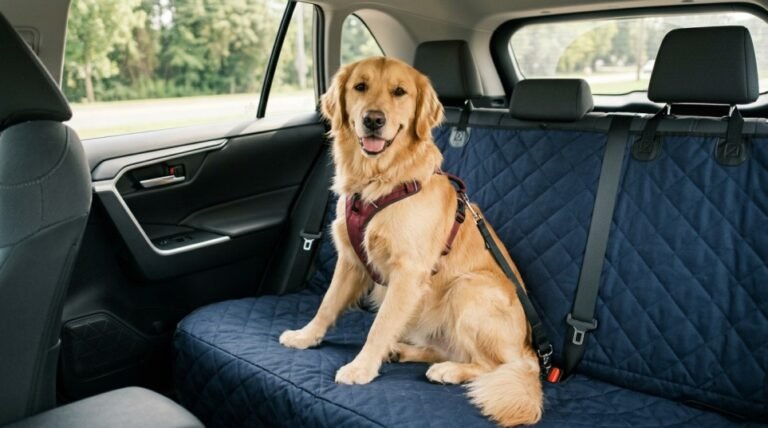
- Crash-tested seat belt harness: The safest non-crate option. Must be tested by an independent lab (not just marketed as crash-tested). Dogs must be buckled into the back seat only. Best for medium dogs on shorter trips.
- Dog car barrier: A metal barrier between the cargo area and the back seat keeps the dog out of the driver area but does not restrain the dog in a crash. Good as a secondary measure alongside a crate or harness.
- Dog seat belt with tether: A short tether that attaches to the vehicle seatbelt and clips to the dog’s harness. Provides some restraint but is not crash-tested in most cases. Better than nothing, not as good as a crate.
- Travel booster seat: Appropriate only for very small dogs. Raises the dog up and includes a tether but provides minimal crash protection. Not recommended for travel speeds over 30 mph.
What to Do If Your Dog Escapes from the Crate in the Car
Even with a properly secured crate, occasionally a dog will learn to unlatch a door or squeeze through a partially open panel. Here is what to do:
While Driving
- Do not reach back to grab the dog. Pull over safely first.
- Use a firm verbal command to keep the dog still if it is moving toward the front.
- Once stopped, return the dog to the crate and secure the door with a secondary latch or carabiner clip.
Preventing Escapes
- Add a secondary lock to wire crate doors. Most wire crate latches can be reinforced with a small padlock or carabiner.
- For soft crates, use a clip or small lock through the zipper pulls.
- Consider a crate with a single locking door rather than a multi-latch design.
- A properly fitted harness tether inside the crate gives the dog freedom to sit, stand, and turn while preventing escape.
Frequently Asked Questions: Dog Cage in Car
Is a dog cage or crate actually necessary in a car?
It is the safest option for most dogs on most trips. An unrestrained dog in a car is a safety risk for both the dog and every passenger. While not legally required in most U.S. states, crash data and physics strongly support using a restraint system for every car trip.
Can I put a dog crate in the front seat?
Only if you can disable the front passenger airbag. An airbag deploying into a crate in a frontal collision can severely injure or kill a dog. The back seat or cargo area of an SUV is always the safer choice.
How do I secure a dog crate in an SUV cargo area?
Use the cargo floor tie-down anchors and ratchet straps rated for at least three times the combined weight of the dog and crate. Run straps front to back and test that the crate does not shift more than one inch in any direction before driving.
What is the best dog cage for car travel?
A crash-tested hard-sided crate with independent test data from the Center for Pet Safety is the best choice. For large dogs in SUVs, purpose-built aluminum dog crates that lock to the cargo floor are also excellent. Avoid soft-sided crates for any trip at highway speeds.
Can my dog sleep in a crate in the car?
Yes, and many dogs prefer it. A familiar crate with a blanket from home is often the best way to keep a dog calm on long road trips. Ensure the crate has adequate ventilation, especially in warm weather, and never leave a dog in a crated car in direct sunlight or above 70 degrees Fahrenheit.
How long can a dog stay in a crate in the car?
Adult dogs can generally stay in a crate for two to four hours comfortably. On longer trips, stop every two to three hours to allow the dog to relieve itself, stretch, drink water, and get a short walk. Puppies, senior dogs, and dogs with health conditions may need more frequent breaks.
What size dog crate do I need for my car?
Measure your dog from nose to tail base and add 4 inches for length. Measure from floor to top of head and add 4 inches for height. Then confirm the crate fits in your vehicle’s cargo area or back seat before purchasing. A crate that fits your dog but not your car is not useful.
Is a dog car harness better than a crate?
A crash-tested crate generally offers better protection than a harness in high-speed crashes, particularly in rollovers and side impacts. A crash-tested harness is a valid alternative for dogs that cannot be crated. An untested harness or a standard walking harness used as a car restraint offers minimal crash protection.
Final Word: Should You Use a Dog Cage in Your Car?
A dog cage in a car is not overprotective. It is the correct baseline for safe dog transport, just as a seatbelt is the correct baseline for human passengers.
The crash physics are clear, the behavioral benefits are documented, and the legal trend is moving toward mandatory restraint in more jurisdictions. Using a crash-tested, properly sized, and correctly secured crate is the single highest-impact thing you can do for your dog’s safety on the road.
If a crate does not work for your dog right now, start with desensitization training. If it truly will not work, use a crash-tested harness as your next best option. An unsecured dog in a car is a risk you can eliminate, and there is no good reason not to.
Sources and References
- Center for Pet Safety: Pet Restraint Testing. centerforpetsafety.org
- AKC: How to Travel Safely with Your Dog. akc.org
- NHTSA: Distracted Driving Research. nhtsa.gov
- Merck Veterinary Manual: Motion Sickness in Dogs. merckvetmanual.com
- The Highway Code: Rule 57, Animals in Vehicles. gov.uk
- PetMD: How to Keep Your Dog Safe in the Car. petmd.com
- Preventive Vet: Dog Car Safety. preventivevet.com

Dr. Ubaid Ur Rehman, DVM is a qualified veterinarian with expertise in pet health, nutrition, and preventive care. He is passionate about helping pet owners make informed decisions through accurate, research-based, and practical advice. As a veterinary professional, he reviews and contributes content to ensure reliable information for dog and pet owners.